
10 Albums that Influenced Kurt Cobain
Updated: Aug 23
Nirvana is a band that has been dissected incessantly, and, as with countless others, played a major role in shaping my musical tastes as a young person. When I stumbled across a copy of Kurt Cobain's Journals at Half Price Books as a teenager, I anxiously read it cover-to-cover. While I had some initial trepidation about reading someone else's diary, Cobain notably wrote "if you read you'll judge" on his personal notebooks, likely aware that they would become a piece of grunge and music history. The main thing I gleaned while reading is that Cobain was readily forthcoming about bands that preceded and were contemporaries of Nirvana who inspired their sound and aesthetics. He famously even handwrote a list of his 50 favorite albums. Below are 10 bands and musicians Cobain—throughout his interviews, writings, and performances—claimed as an inspiration or paid homage to.
Melvins - Stoner Witch (1994)

Song Selection: "Queen"
The first ever rock band Kurt Cobain saw perform was when he went to a practice session of the Melvins, a young band from Montesano, Washington. A friend of a friend of Kurt's got them an invite to see the Melvins practice in an attic. At this point they were just a high school band playing Hendrix and Who covers, as noted in Michael Azerrad's The Amplified Come as You Are: The Story of Nirvana, but:
"It was the first time Kurt had seen a real rock band up close and he was terrifically excited. 'I'd been drinking wine all night and I was really drunk and obnoxious and I remember complimenting them about a million times,' says Kurt. 'I was so excited to see people my age in a band. It was so great. I was thinking, 'Wow, those guys are so lucky.' Disgusted with this fawning little squirt, they kicked Kurt out. Still drunk, he fell down the attic ladder as he left" (Azerrad 56).
Kurt later befriended several band members when he transferred to Montesano High for a spell after his parents' divorce. He would sometimes act as a roadie when they went to Seattle and even auditioned for the band at one point but "totally botched it" (Azerrad 63). The Melvins became known for metal-infused punk, in the vein of Black Sabbath, and Cobain helped promote the band after gaining notoriety by citing them as a major influence on his development.
Creedence Clearwater Revival: Green River (1969)

Song Selection: "Bad Moon Rising"
An early version of Nirvana actually began with Kurt Cobain and Krist Novoselic as a short-lived Creedence Clearwater Revival cover band that called themselves the Sell-Outs. They named and created the group because they realized the Melvins made eighty dollars a night to play, and they decided to cash in. This particular version of the band was sabotaged as the third member, Steve Newman, and Cobain had a fight in which:
"Newman tried to attack Kurt with a vacuum cleaner. Kurt grabbed a two-by-four and brained his much larger opponent" (Azerrad 100).
Azerrad notes that while the aim may have been partially cynical, Cobain's admiration for Creedence Clearwater Revival was legitimate. A photo of Cobain playing guitar in his teens included a copy of their 1970 release Cosmo's Factory. The sonic influence appears self-evident, and, early in their careers, Nirvana would use "Bad Moon Rising" as an encore track. The Sell-Outs, while only lasting a few gigs, proved an important milestone in Kurt and Krist making music together and beginning to piece together their sounds and inspirations.
The Vaselines - Dying For It* (1992)
*listed as Pink EP on Cobain's top 50 albums

Song Selection: "Son of A Gun"
Nirvana not only famously covered "Jesus Wants Me For a Sunbeam" (listed as "Jesus Doesn't Want Me for a Sunbeam") on MTV Unplugged in New York, but they also have live covers of "Molly's Lips" on the Deluxe Edition of Bleach and "Son of a Gun" in their BBC 1990 John Peel Sessions. The Vaselines were an alt-rock/indie pop band, but they often incorporated experimental themes and elements, such as a clownish horn erratically sounding in the background of "Molly's Lips." When Nirvana first recorded an electric cover of "Jesus Doesn't Want Me For a Sunbeam" for Live at the Paramount in 1991, Cobain introduced the track by saying: "This song is written by a band called the Vaselines, they're from Edinburgh Scotland, and they're very punk rock." This statement shows Cobain viewed punk not so much as a cohesive sound or genre, but a sort of ethos or attitude towards society and creating music that could be adopted by artists with diverse aesthetics. This is perhaps because Cobain was not exactly sure what punk music was when he decided he was interested in it:
"Somewhere around the summer before tenth grade, Kurt began following the exploits of the Sex Pistols in Creem Magazine. The idea of punk rock fascinated his. Unfortunately, the record store in Aberdeen didn't stock any punk rock records, so he didn't know what it sounded like. Alone in his room, he played what he thought it sounded like—'Three chords and a lot of screaming'" (Azerrad 50).
I have included both their electric and acoustic covers in the Nirvana Covers playlist at the end of this article, as the two are rather interesting to compare, along with other tracks the band covered mentioned herein.
Lead Belly - Lead Belly's Last Sessions Vol. 1 (1948)
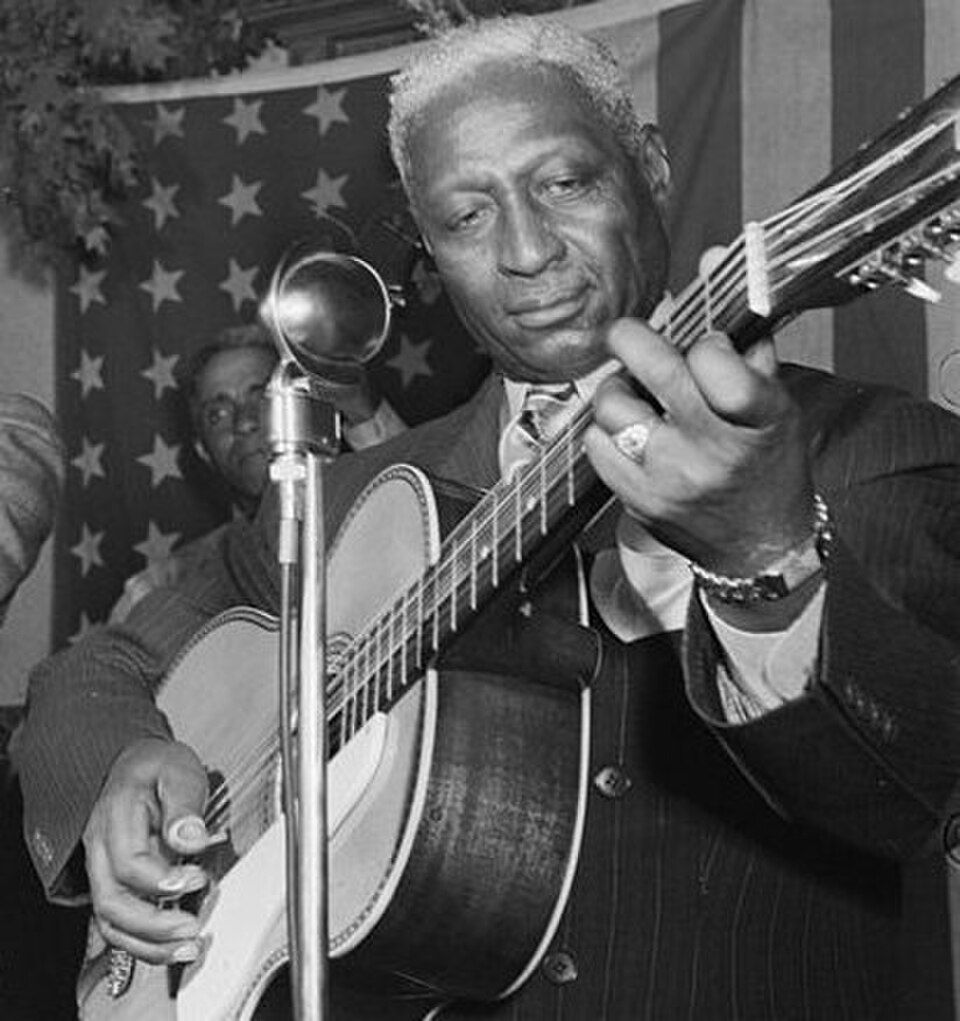
Song Selection: "He Never Said a Mumbling Word - 1"
Another song Cobain covered during MTV Unplugged was "Where Did You Sleep Last Night" by folk singer and blues legend Lead Belly. Cobain frequently wrote in his journals of his deep admiration for Lead Belly's Last Sessions album, saying "It's something that I hold really sacred to me. . . Lead Belly is one of the most important things in my life. I'm totally obsessed with him" (Azerrad). He covered several of his tracks, although the names are often listed differently. Along with the religious refusal that attracted him to "Jesus Wants Me For a Sunbeam," the tracks "Ain't It a Shame" (listed in Last Sessions as "Ain't It a Shame to Go Fishin' on Sunday") and "They Hung Him on a Cross" (listed originally as "He Never Said a Mumbling Word") contain similar themes that would have been quite provocative for the time. The original lyrics of "Ain't It a Shame to Go Fishin' on Sunday" begin innocuously enough by stating activities one should reserve for the rest of the week to respect the Lord's Day, such as fishing, kissing a girl, or having a drink, before the repetition becomes darkly ironic:
"Ain’t it a shame to beat your wife on Sunday / When you got Monday, Tuesday, Wednesday / Oh Thursday, Friday, Saturday"
Cobain amplifies the Christian hypocrisy dissected on both tracks by repeatedly screaming the word "Shame" towards the end of his recording.
Meat Puppets - II (1984)

Song Selection: "Plateau"
To complete this section of bands that were covered during MTV's Unplugged performance, the Meat Puppets were actually present and joined Nirvana onstage to cover their songs "Plateau," "Oh Me," and "Lake of Fire." They were touring with Nirvana at the time, but:
"Before Kurt Cobain uttered their name during the 1993 taping of MTV Unplugged, most people had never heard of the Meat Puppets. Even fewer people would have recognized brothers Curt and Cris Kirkwood sitting on stage with Nirvana, had Cobain not shouted them out specifically" (AV Club).
The Meat Puppets utilized more psychedelia-influenced guitar sounds, which Kurt thought would translate well for an acoustic performance. However, both Kurt and Curt share not just a name, but raw, raspy vocals that alternate effortlessly between screaming and gentle, laid-back melodies.
Sonic Youth - Daydream Nation (1988)

Song Selection: "Candle (Album Version)"
Kurt Cobain was close friends with frontwoman Kim Gordon and claimed Sonic Youth as a primary influence. She helped to promote their music early on and encouraged him to sign to their same record label, Geffen. Nirvana toured with Sonic Youth before releasing Nevermind, often playing unreleased tracks.
Cobain considered himself a feminist, and he was consistently inspired by and publicly supported female musicians and artists. In her memoir, Girl in a Band, Gordon described her initial impressions of Cobain,
"Standing in front of me, Kurt seemed small, close to my height, though he was actually 5ft 9in to my 5ft 5in. He had big, watery eyes, slightly hunted looking. I’m not sure why, but I felt an immediate kinship with him. When Nirvana toured with us in 1991, before Nevermind broke, no one in Europe knew who they were. Kurt was funny and fun to be around, and soaked up any kind of personal attention. I felt very big sisterly, almost maternal, when we were together."
Gordon also produced Hole's first album, Pretty on the Inside, although the memoir details a rockier relationship with Courtney Love, perhaps due to the cautious maternal sensibility Gordon notes above.
Pixies - Surfer Rosa (1988)

Song Selection: "Cactus - 2007 Remaster"
Kurt openly admired Pixies, at one point describing the genesis of "Smells Like Teen Spirit" in a 1994 interview with Rolling Stone by saying:
"I was trying to write the ultimate pop song. I was basically trying to rip off the Pixies. I have to admit it [smiles]. When I heard the Pixies for the first time, I connected with that band so heavily I should have been in that band — or at least in a Pixies cover band. We used their sense of dynamics, being soft and quiet and then loud and hard."
He included not only Surfer Rosa on his list of his 50 favorite albums, but also Pod by The Breeders, the later project of bassist and vocalist Kim Deal. He particularly spoke about his love for Deal's songwriting and expressed that he wished she had been allowed more creative control while with the Pixies:
“'I wish Kim was allowed to write more songs for the Pixies,' he stated in 1992, 'Because ‘Gigantic’ is the best Pixies song and Kim wrote it'” (Far Out Magazine).
The Slits - Cut* (1979)
*listed as Typical Girls on Cobain's Top 50 Albums

Song Selection: "Instant Hit"
The Slits exploded onto the punk scene as relative unknowns who managed to secure a spot opening for The Clash at the Roxy Club in London and on the White Riot Tour. They are sometimes called the "first female punk bank" and found their sound on Cut with producer Dennis Bovell when they began incorporating reggae influences. They profoundly shaped later riot grrl bands and movements of the 90s. While The Slits often received a more mixed reception and were viewed as more controversial in sound and aesthetics than their male counterparts of the era, their impact on the history of post-punk and the sound of figureheads like Kurt Cobain and Kim Gordon is undeniable.
Black Flag - Damaged (1981)

Song Selection: "Police Story"
While Kurt Cobain included perhaps less overtly political themes in his songwriting than earlier punk bands like Black Flag who influenced him, his leanings and personal morals are exemplified in several statements made to his audiences and in the innate feminism demonstrated in several of the narrative perspectives he adopted. On "Been a Son" and "Polly," Cobain adopts the perspective of female victims of societal degradation and direct male violence, respectively. He also spoke out against racism, sexism, and homophobia regularly, at concerts, in interviews, and even on Nirvana's album packaging:
"While promoting Nirvana's late-1992 compilation album Incesticide -- which included the following statement in its liner notes, 'If any of you in any way hate homosexuals, people of different color, or women, please do this one favor for us: leave us the fuck alone! Don't come to our shows and don't buy our records' -- Cobain spoke to The Advocate, granting the LGBTQ publication his only interview at that precarious time" (The Advocate).
I felt Kurt would appreciate this particular song because, from the time he was a toddler, he hated cops.
"When he'd spot one, he'd sing a little song. 'Corn on the cops, corn on the cops! The cops are coming! They're going to kill you!' 'Every time I saw a cop I'd start singing that at them and pointing at them and telling them that they were evil . . . I had this massive thing about cops. I didn't like them at all'" (Azerrad 38).
The Cars - The Cars (1978)

Song Selection: "My Best Friend's Girl"
The Cars, with their New Wave sound and glam rock aesthetics, may stand out as an odd choice for this list of Cobain's musical influences. However, "My Best Friend's Girl" was one of the first songs Cobain learned to play on the guitar (Azerrad 49). And, oddly enough, Nirvana covered this very track during their last concert in Munich, Germany on March 1st, 1994. Krist Novoselic contributed backing vocals, which was highly unusual for the band. It is both tragic and synchronicitous that Kurt and the band would remember such an early moment in his process of sonic and self-discovery right before things ended as they did.
Check out the playlists below for this article below. What do you want to read about next on Enharmonic Magazine? Let us know in the comments.


Comments