
Review: Ninajirachi "I Love My Computer"
I Love My Computer by Ninajirachi purports to take the sentiment quite literally at times, such as in the title of the hardcore EDM track "Fuck My Computer." However, Nina's lyrics aren't alluding to some AI-fueled, dystopian fantasy. In the song, Nina states “I wanna fuck my computer / ’Cause no one in the world knows me better, / It says my name, it says, ‘Nina’ / And no one in the world does it better.” Yet the pronunciation of 'Nina' is a muddle of cartoonish beeping noises, and I genuinely did not realize it was meant to resemble her name at all at first. There is no desire for her machine to be humanoid or speak fluently in her own language (a technology already implanted in most new phones and computers with features like Siri and AI chatbots). Songs like "iPod Touch" and her album cover and music video visuals of boxy early 2000s PCs evoke memories of digital life that are nostalgic and tactile. The album is a consistent examination of how this increasingly retrograde notion of the computer has enmeshed itself within Nina's (and her listeners') upbringing, sociality, and sense of reality and possibility. And, while maintaining a sense of nuance, the album remains optimistic about how computers can and have enabled artists like Ninajirachi to create art in new and widely accessible ways.
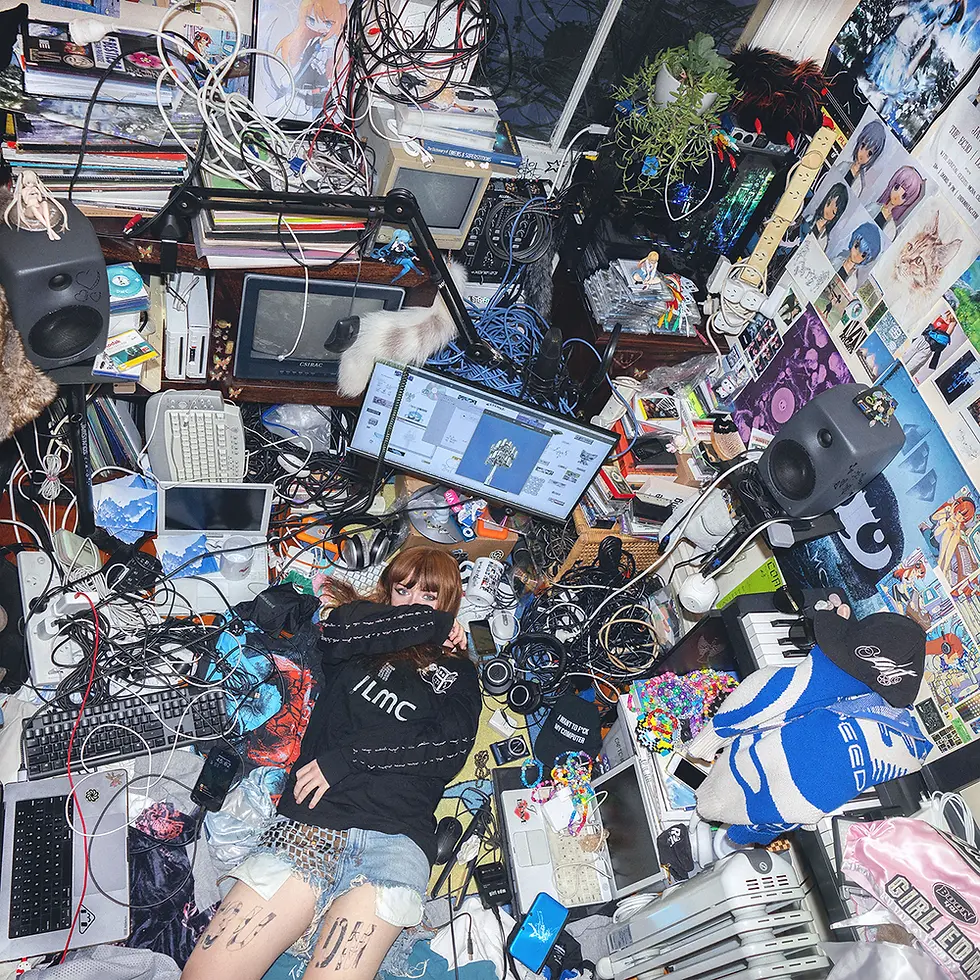
On the track "Infohazard," humans and their images are actually intrusive to the safe space of the computer screen and digital world. Nick Bostrom of Oxford University coined the term Information Hazard or Infohazard in 2011 to denote "risks that arise from the dissemination or the potential dissemination of true information that may cause harm or enable some agent to cause harm." One might argue the internet has essentially defeated the human capacity to truly withhold potentially dangerous information from those who might seek it. Nina uses the Infohazard as a metaphor for growing up online, where she would come into contact with images and information she was not equipped to interpret or understand as a child. Her lyrics serve as a sort of reckoning and interrogate the impact this may have had on her psychological development.
"In my dream, I saw him / The man without a head / On my screen, I saw him/When I was four and ten / I didn't mean to see him / It all happened so fast / What does it mean to see him / Now all this time has passed?"
Nina's songs really remind me of what it did feel like to be online in the 2000s and 2010s, something almost secretive and glitchy, clicking through interfaces that would be considered esoteric now. The album is bright and rapid, but still makes room for these moments of loading, errors, and unnerving chance encounters. The whole album is a love letter to the digital technologies which have enabled artists like ninajirachi to listen to, create, and share digital music and how these snippets of song have become embedded in our personal, collective, and electronic consciousness. Her personal history becomes collective through the shared experience of the internet.
My favorite aspect of the album was the excellent transition sequences between tracks, notably between "London Song" and "iPod Touch", then "iPod Touch" and "Fuck my Computer.""iPod Touch" was definitely the song of the summer for me personally. The song offers a glimpse at the nostalgia digital archives and physical media can offer to the user, especially one who came of age during the heyday of the titular device.
"It sounds like iPod Touch, yellow Pikachu case / FL Studio free download in my search history / Hidden underneath my pillow 'cause I should be asleep / It sounds like, I'm keepin' it a secret / It sounds like I've got a song that nobody knows / And I heard it in a post when I was twelve years old / I didn't know it would score the 64-bus home / Turn a Monday to a memory and change my world"
One thing the I Love My Computer album manages that other up-and-coming EDM releases often lack is the sense of narrative place and artistic struggle that manifest on the track "Sing Good." Nina consistently creates a sense of hyperlocality by citing Australian bus lines, cities, and landmarks.
"I used to get the bus to school, the time was all it costed / It took about an hour to get from Kincumber to Gosford / One headphone in my ear, the other one in Zahra's / Phases movin' faster than the wheels / I used to look the lyrics up and Google, 'What's a chorus?'/ Wrote some of my own and used GarageBand to record it / 'Cause I can't really sing good, but I'm still gonna try it / I might even like the way it feels"
This singular setting also helps us to understand a sense of cultural estrangement that the digital world seems to help counterbalance for Nina. On the first track, "London Song," the chorus makes clear that Nina has certain ideas about London that have been built through information technologies, but she has never been herself. Small moments of online and IRL connection help to balance the sense of isolation that otherwise might be a predominant theme of the album.
Funnily enough, at the time I got seriously into listening (and re-listening) to this album, I was taking a train about an hour each way to get to work. There was something comforting and intriguing for me about how Nina consistently links public transportation with listening to music on a digital device while experiencing the same phenomenon myself. While many of the tracks on I Love My Computer initially appear more appropriate for a rave or a club, the personal nature of the album and Nina's insistence on electronic music and mundane experiences being a connective tissue within and between memories kept me piping this album through my earbuds. It made me reconsider the liminal space of the train and my commute, offering the experience a new positive valence and potential significance. Rather than escaping into my phone or headphones, I achieved a sort of synthesis within my own commute that allowed the train to be both a space of reflection and a potential portal of connection to others' experiences.
In an EDM genre that often succeeds when creating pure fantasies, Ninajirachi's true accomplishment consists of adding a surreal and magical lens to the everyday. The album reaffirms that—despite recent trending towards predatory algorithms, AI slop, and social media ragebait—being online can still be fun when we use digital tools to create the spaces we dream of. Ninajirachi has cracked the code of how to make electronic music that is technically advanced and novel, yet hauntingly familiar.
What do you want to see covered in Enharmonic Magazine next? Let us know in the comments.


Comments