
Art in the Age of "Machines": A Q&A with Ethanplus
If you're into glitch, hardcore EDM, or are just looking for an immersive, escapist, and fun album to distract from well, everything, then you have arrived at the correct place! Ethanplus' Machines seamlessly balances nostalgic club sounds, the uncanny experience of being human in an increasingly digital world, and a deep love of the digital technology that makes his music possible. Based in Brisbane, Ethanplus' work is emerging from the same Austrailian EDM scene that has been producing breakout stars like Ninajirachi, Daine, and Alison Wonderland. You can follow Ethanplus' rise on his Instagram and Tiktok. A huge thank you to Ethan for participating in the Q&A below!
Q: Who are you listening to right now? Which dream collaboration are you manifesting?
A: Right now I'm listening to quite a mix of stuff honestly! Lots of glitchier Machines type stuff as well as some mainstream pop throwbacks. But of course the likes of Jane Remover, Underscores and Ninajirachi are always in the mix, and all of them would definitely be a dream to collaborate with!
Q: The Machines cover art is amazing. I love the campy view of technology throughout the album visuals, especially the contrast between the technical prowess of album and the clunky, retro, humorous notions of futuristic technology being displayed. The focus on wearables and immersive or embedded devices made me think, are we all becoming extensions of machines? Did the notion of a DJ as an extension of computer systems and decks play into the visual concepts for the album?

A: Thank you so much! Massive thank you and shoutout to YINGURAY who shot the cover and really pushed me to make all that tech gear look as good as it could be! I've always been fascinated by ideas like transhumanism and futurism - I think you're right in noticing that it ties into electronic music somewhat. For some electronic artists I think they really try to distance themselves from it, opting to minimise the 'electronic' aspect in favour of more organic sounds and modes of performance. But for me I wanted to stay true to the fact that I've always been very attached to technology, and I wanted to show that off kind of unapologetically, and I think that is definitely the driving concept behind the album.
Q: I love the idea of machines as a portal for connection, especially through electronic music, on "Connecting Us." It made me think of this Ninajirachi quote about experiencing club culture and EDM music through digital landscapes first: "All of my club music listening was at home or on the bus, so it wasn't until I started playing shows that I understood the context for which they were made.” Would that be an experience that is relatable for you as well?
A: Definitely! Even now, I'm not really that into club culture and I sometimes feel like a bit of an outsider in that regard (this is kind of what inspired my previous body of work, DAYCLUB). But the power of the internet and the music has shown me there are plenty out there who feel the same! I think there is a type of person who is very into the traditional format of dark rooms, non-stop music and focus on the dancefloor and then there is the type who is all about pushing the grandiosity and showmanship of what EDM can be both sonically and visually. Both are valid and very important to the history of how these scenes develop, but I'm definitely part of the latter camp! And a lot of that comes down to the fact that we have alternate methods of discovery and connection to music these days.
Q: Speaking of Ninajirachi, what, in your opinion, is it about the Australian EDM scene that is causing it to explode onto the global stage?
A: I don't know for sure, but my personal theory is this: in electronic music, listeners crave a balance between familiarity and radical innovation. I think Australian artists are naturally inclined to strike that balance because while the sights and sounds of EDM are easily imported to us, we are geographically very isolated from the rest of the world's EDM cultures at their physical sources, so that leaves room for our interpretations to be a little different. I think it's kind of like when people use the analogy "if an alien tried to make...". The other point is that we are fortunate enough to have things like Triple J and other bodies that really put in an effort to foster upcoming artists and get them heard!
"In electronic music, listeners crave a balance between familiarity and radical innovation. . . Australian artists are naturally inclined to strike that balance because while the sights and sounds of EDM are easily imported to us, we are geographically very isolated from the rest of the world's EDM cultures. . ."
Q: I follow you on Instagram and saw you reposting clips of artists like Nina, Porter Robinson, Hudson Mohawke, and more incorporating tracks from the Machines album in DJ sets. How does it feel to be not only noticed by but actually incorporated into the artistic expression of such icons in the space?
A: It is so, so awesome! Especially since these are artists I've been listening to for years, and some of them since before I even touched a DJ controller or opened a DAW for the first time. They also all have massive catalogues of original music themselves, so for them to allow space in their set to showcase one of my tracks that could have been used to spin a fan favourite of their own is such a massive honour. I feel very seen and connected to the scene when that kind of thing happens.
Q: Your Spotify bio describes you as a “Whacky electronic music jester and audiovisual chaos producer.” I loved your posts that the Machines album was rated “much higher than the soundtrack for the movie Inspector Gadget” and a disclaimer that you wouldn’t be performing at Coachella this year due to "not being booked in the first place as a logistical challenge leading to the last-minute cancellation decision.” When and how do you think humor became an important part of your persona and self-marketing?
A: It's definitely been there from the start in one way or another. I think that kind of humour has been part of my real life personality for as long as I can remember, and I try to keep my artist project as an exaggeration of who I am in real life (hence ethanplus). But definitely in the past few years as the social media landscape throws out its twists and turns, I've been experimenting with different ways to catch attention while still being true to myself, and that's where a lot of these kinds of posts come from. It can be hard trying to strike a balance between being taken seriously while also having a sense of humour, but I'm very interested in that dichotomy so it's a challenge I welcome with open arms.
Q: Machines is a 17 minute album that still contains so much. It's maximalist, but almost entirely void of legible lyrics besides the track "Symbiosis." Why was the line "I'm running back to you" the one moment of lyrical intercession that you thought was important?
A: I've never been huge on lyrics and I don't really pay a lot of attention to lyrics when I listen to songs, more just the voice's sound itself. But "Symbiosis" is definitely a climactic point in the narrative of the album, it's about a perfect harmony between human and machine. The "I'm running back to you" line has a little bit of a romantic connotation, but when I found that sample I thought it would be cool to recontextualise it in the track as the 'marrying' of the biological and the technological.
Q: I love the portmanteau "Automagically." When new technologies often seem increasingly oppressive for artists, how do you help create a whimsical and truly generative relationship with the machines amongst us?
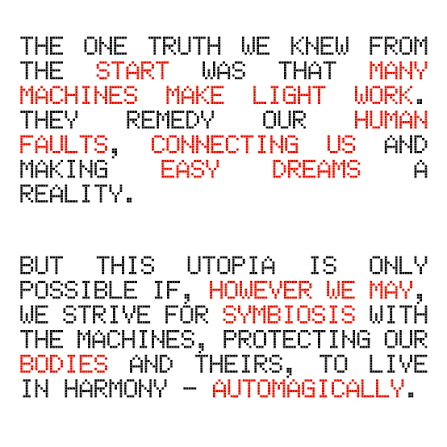
A: Great question - and I think it leads into an overarching message from the album which is that technology itself isn't inherently bad, it's our relationship with it that determines how things play out. Technology must adapt to us equally as much as we adapt to technology. If we are bending ourselves too much in the interests of technology, it's oppressive for us, and likewise bending technology too much in the interests of the 'natural' or 'traditional' state of humanity will only leave us with technology that is as flawed and chaotic as we are. To unlock true potential for both humans and machines, progress must be made in unison - symbiotically, automagically, if you will!
What do you want to see covered in Enharmonic Magazine next? Let us know in the comments.


Comments